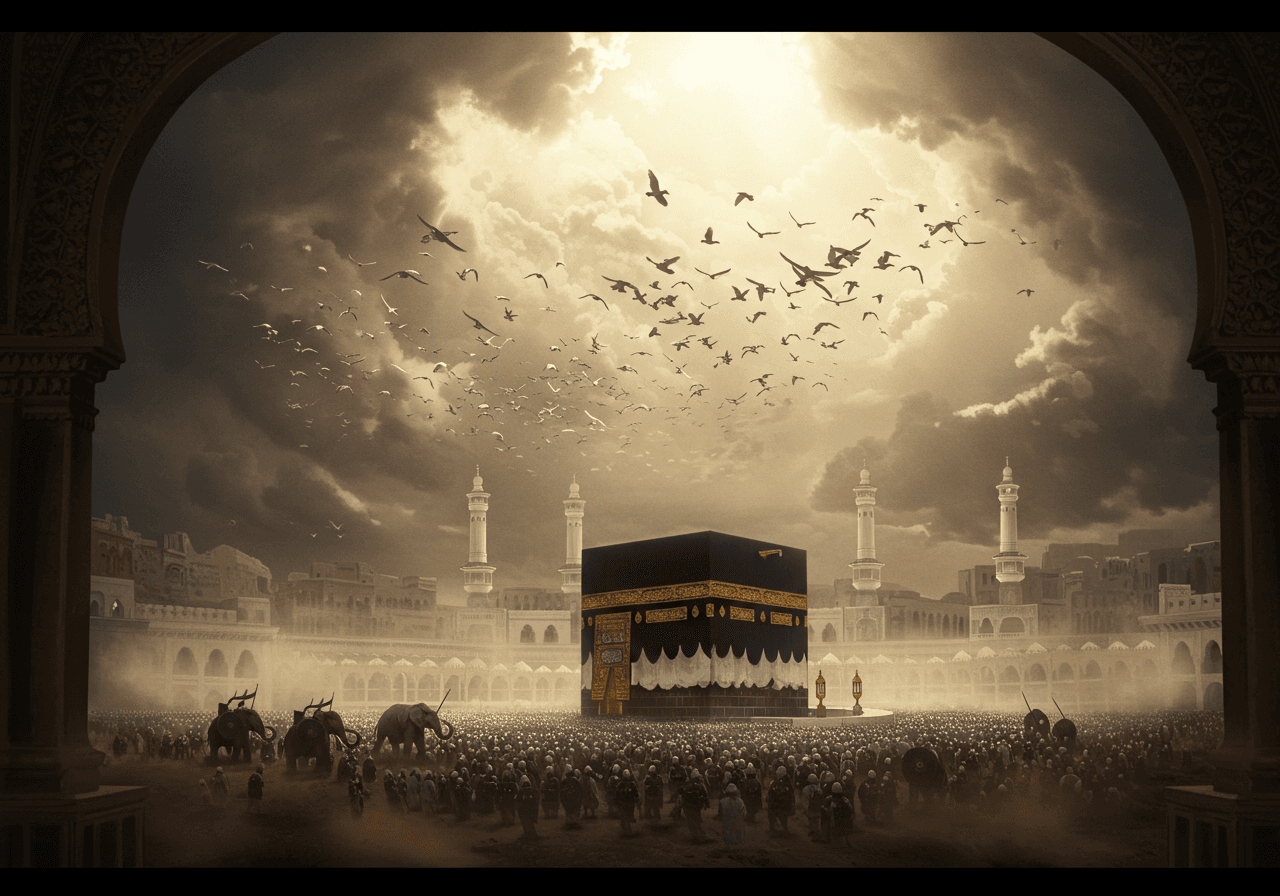
In the year 570, a powerful ruler from Yemen named Abraha set his sights on Mecca. His goal was not trade or diplomacy, but destruction. He wanted to demolish the Kaaba, the sacred house built by Prophets Ibrahim and Ismail, so that he could divert all pilgrims to his own grand cathedral in Yemen.
Abraha gathered a massive army, the likes of which Arabia had never seen. At its head was a colossal elephant named Mahmud, a creature so imposing that it struck fear into the hearts of all who saw it. As the army approached Mecca, the local tribes knew they were no match and retreated to the surrounding mountains, leaving the city defenseless.
The grandfather of the Prophet, Abdul-Muttalib, who was the custodian of the Kaaba, put his complete trust in Allah. He famously said, "The House has its Lord who will protect it."
As Abraha and his army prepared for their final assault, the lead elephant, Mahmud, knelt and refused to move towards the Kaaba. No matter how much they pushed or prodded, it would not advance. Then, a miracle occurred. From the direction of the sea, a dark cloud appeared. It was not a storm cloud, but a vast flock of tiny birds, called Ababil.
Each bird carried three small stones, one in its beak and one in each claw. They flew over Abraha's army and dropped the pebbles. Each stone, by the will of Allah, struck the soldiers with such force that it left them devastated, like "eaten straw," as the Quran describes. Abraha's army was completely destroyed, and the Kaaba was saved.
This event was so profound that the year became known as the 'Am al-Fil, or "The Year of the Elephant." And it was in this very same year that the final Messenger to humanity, Prophet Muhammad (peace be upon him), was born.
Knowledge Check
Test your understanding to complete this lesson.
Quiz coming soon.